

Chesterton on Orthodoxy
It is not a poor witness.

The whole scene indeed, seriousness apart, might be regarded as a fantasia for barbers; for the different ways of dressing the hair would alone serve as symbols of different races and religions. Thus the Greek priests of the Orthodox Church, bearded and robed in black with black towers upon their heads, have for some strange reason their hair bound up behind like a woman’s. In any case they have in their pomp a touch of the bearded bulls of Assyrian sculpture; and this strange fashion of curling if not oiling the Assyrian bull gives the newcomer an indescribable and illogical impression of the unnatural sublimity of archaic art. In the Apocalypse somewhere there is an inspiringly unintelligible allusion to men coming on the earth, whose hair is like the hair of women and their teeth like the teeth of lions. I have never been bitten by an Orthodox clergyman, and cannot say whether his teeth are at all leonine; though I have seen seven of them together enjoying their lunch at an hotel with decorum and dispatch. But the twisting of the hair in the womanish fashion does for us touch that note of the abnormal which the mystic meant to convey in his poetry, and which others feel rather as a recoil into humour. The best and last touch to this topsy-turvydom was given when a lady, observing one of these reverend gentlemen who for some reason did not carry this curious coiffure, exclaimed, in a tone of heartrending surprise and distress, “Oh, he’s bobbed his hair!”
Here again of course even a superficial glance at the pageant of the street should not be content with its comedy. There is an intellectual interest in the external pomp and air of placid power in these ordinary Orthodox parish priests; especially if we compare them with the comparatively prosaic and jog-trot good nature of the Roman monks, called in this country the Latins. Mingling in the same crowd with these black-robed pontiffs can be seen shaven men in brown habits who seem in comparison to be both busy and obscure. These are the sons of St. Francis, who came to the East with a grand simplicity and thought to finish the Crusades with a smile. The spectator will be wise to accept this first contrast that strikes the eye with an impartial intellectual interest; it has nothing to do with personal character, of course, and many Greek priests are as simple in their tastes as they are charming in their manners; while any Roman priests can find as much ritual as they may happen to want in other aspects of their own religion. But it is broadly true that Roman and Greek Catholicism are contrasted in this way in this country; and the contrast is the flat contrary to all our customary associations in the West. In the East it is Roman Catholicism that stands for much that we associate with Protestantism. It is Roman Catholicism that is by comparison plain and practical and scornful of superstition and concerned for social work. It is Greek Catholicism that is stiff with gold and gorgeous with ceremonial, with its hold on ancient history and its inheritance of imperial tradition. In the cant of our own society, we may say it is the Roman who rationalises and the Greek who Romanises. It is the Roman Catholic who is impatient with Russian and Greek childishness, and perpetually appealing for common sense. It is the Greek who defends such childishness as childlike faith and would rebuke such common sense as common scepticism. I do not speak of the theological tenets or even the deeper emotions involved, but only, as I have said, of contrasts visible even in the street. And the whole difference is sufficiently suggested in two phrases I heard within a few days. A distinguished Anglo-Catholic, who has himself much sympathy with the Greek Orthodox traditions, said to me, “After all, the Romans were the first Puritans.” And I heard that a Franciscan, being told that this Englishman and perhaps the English generally were disposed to make an alliance with the Greek Church, had only said by way of comment, “And a good thing too, the Greeks might do something at last.”
Anyhow the first impression is that the Greek is more gorgeous in black than the Roman in colours. But the Greek of course can also appear in colours, especially in those eternal forms of frozen yet fiery colours which we call jewels. I have seen the Greek Patriarch, that magnificent old gentleman, walking down the street like an emperor in the Arabian Nights, hung all over with historic jewels as thick as beads or buttons, with a gigantic cross of solid emeralds that might have been given him by the green genii of the sea, if any of the genii are Christians. These things are toys, but I am entirely in favour of toys; and rubies and emeralds are almost as intoxicating as that sort of lustrous coloured paper they put inside Christmas crackers. This beauty has been best achieved in the North in the glory of coloured glass; and I have seen great Gothic windows in which one could really believe that the robes of martyrs were giant rubies or the starry sky a single enormous sapphire. But the colours of the West are transparent, the colours of the East opaque. I have spoken of the Arabian Nights, and there is really a touch of them even in the Christian churches, perhaps increased with a tradition of early Christian secrecy. There are glimpses of gorgeously tiled walls, of blue curtains and green doors and golden inner chambers, that are just like the entrance to an Eastern tale. The Orthodox are at least more oriental in the sense of being more ornamental; more flat and decorative. The Romans are more Western, I might even say more modern, in the sense of having more realism even in their ritualism. The Greek cross is a cross; the Roman cross is a crucifix.
It is truer to say that the Latin cleaves to the Crucifixion; the Orthodox to the Resurrection.
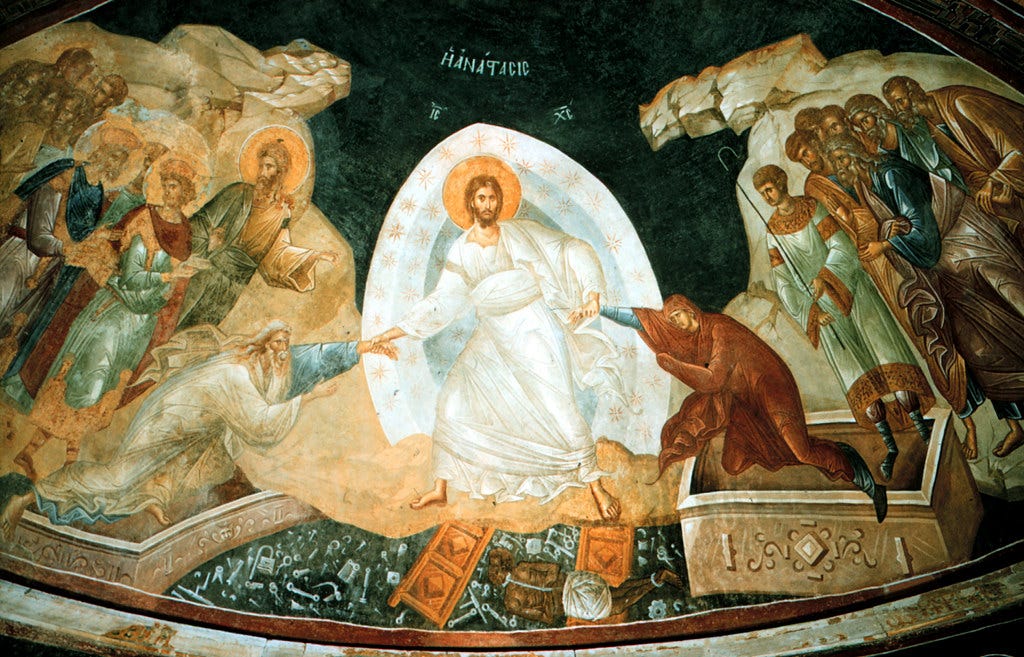
This is the difference lying in the heart of Christendom. That the sun rises in the East and sets in the West. Neither are less than the other and it dishonors God to abrogate either. After all, if the sun wasn't to fall, how could it rise again. But here lies a prophesy: Just as Jesus returns from the East to renew and unite Heaven and Eden, so will Orthodoxy renew and unite the Church and West.
May God grant you grace, faith, and good fortune.
—Luke Karoly