

The Wanderer — Short Assay
Not wholly poetry.

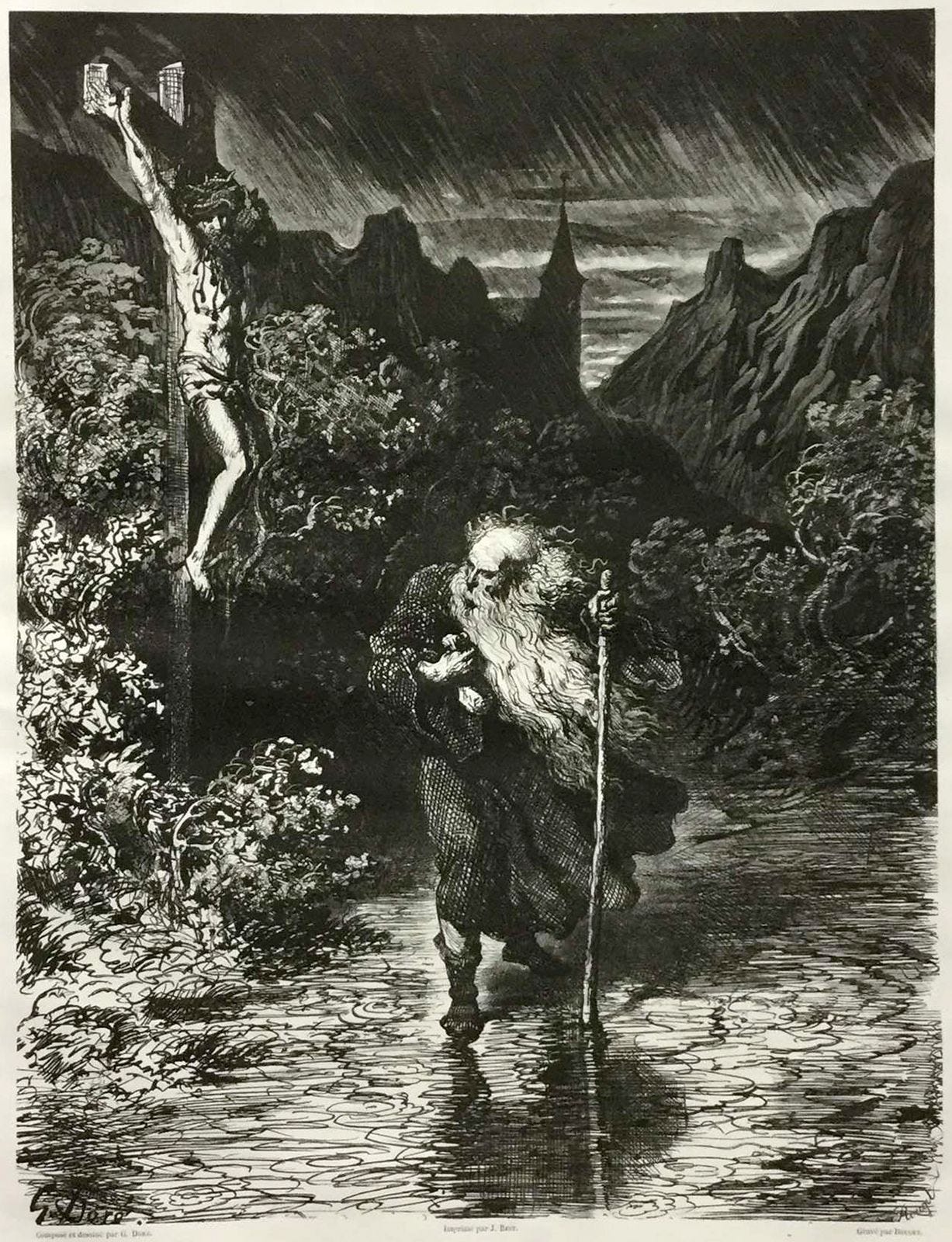
Many figures formed of memory and myth wandered in the world: Paul Bunyan and Babe, William Tell, Merlin, and Midas. Some wander yet still and the greatest of these: Ahasuerus.
It is he who gave Hitler the hand of Napoleon, once the hand of the roman fiddler. It is he who was a shoemaker and cursed to wander, a Christian hermit. He who is Lazarus eternal, he, Judas who hell and earth refused to keep, Odin and Earlking and father of the Rothschilds. As Leibowitz, he preserved civilization in the wilderness, as Goddard, he build the rockets of mankind’s penultimate leap yet could not leave Earth.
He is the Wandering Jew. I met him once. Red-haired and long legged with green eyes looking past the sun’s rising. It was a small mountain town with one bar and three snowmobiles by the old horses’ hitching post. Dusk had drawn her warm covers over the western sky and the first evening star gleamed when he entered the bar.
He spoke, but what he spoke is a story for another day. In parting, he left two old sheafs of paper, the two poems writ below.
I saw by looking in his eyes
That they remembered everything;
And this was how I came to know
That he was here, still wandering.
For though the figure and the scene
Were never to be reconciled,
I knew the man as I had known
His image when I was a child.

With evidence at every turn,
I should have held it safe to guess
That all the newness of New York
Had nothing new in loneliness;
Yet here was one who might be Noah,
Or Nathan, or Abimelech,
Or Lamech, out of ages lost,—
Or, more than all, Melchizedek.

Assured that he was none of these,
I gave them back their names again,
To scan once more those endless eyes
Where all my questions ended then.
I found in them what they revealed
That I shall not live to forget,
And wondered if they found in mine
Compassion that I might regret.

Pity, I learned, was not the least
Of time’s offending benefits
That had now for so long impugned
The conservation of his wits:
Rather it was that I should yield,
Alone, the fealty that presents
The tribute of a tempered ear
To an untempered eloquence.

Before I pondered long enough
On whence he came and who he was,
I trembled at his ringing wealth
Of manifold anathemas;
I wondered, while he seared the world,
What new defection ailed the race,
And if it mattered how remote
Our fathers were from such a place.

Before there was an hour for me
To contemplate with less concern
The crumbling realm awaiting us
Than his that was beyond return,
A dawning on the dust of years
Had shaped with an elusive light
Mirages of remembered scenes
That were no longer for the sight.

For now the gloom that hid the man
Became a daylight on his wrath,
And one wherein my fancy viewed
New lions ramping in his path.
The old were dead and had no fangs,
Wherefore he loved them—seeing not
They were the same that in their time
Had eaten everything they caught.

The world around him was a gift
Of anguish to his eyes and ears,
And one that he had long reviled
As fit for devils, not for seers.
Where, then, was there a place for him
That on this other side of death
Saw nothing good, as he had seen
No good come out of Nazareth?

Yet here there was a reticence,
And I believe his only one,
That hushed him as if he beheld
A Presence that would not be gone.
In such a silence he confessed
How much there was to be denied;
And he would look at me and live,
As others might have looked and died.

As if at last he knew again
That he had always known, his eyes
Were like to those of one who gazed
On those of One who never dies.
For such a moment he revealed
What life has in it to be lost;
And I could ask if what I saw,
Before me there, was man or ghost.

He may have died so many times
That all there was of him to see
Was pride, that kept itself alive
As too rebellious to be free;
He may have told, when more than once
Humility seemed imminent,
How many a lonely time in vain
The Second Coming came and went.

Whether he still defies or not
The failure of an angry task
That relegates him out of time
To chaos, I can only ask.
But as I knew him, so he was;
And somewhere among men to-day
Those old, unyielding eyes may flash,
And flinch—and look the other way.
The Wandering Jew once said to me,
I passed through a city in the cool of the year;
A man in the garden plucked fruit from a tree.
I asked: "How long has the city been here?"
And he answered me, as he plucked away—
"It always stood where it stands to-day,
And here it will stand forever and aye."
Five hundred years rolled by, and then
I traveled the self-same road again.

No trace of the city there I found:
A shepherd sat blowing his pipe alone;
His flock went quietly nibbling round.
I asked: "How long has the city been gone?"
And he answered me, and he piped away—
"The new ones bloom and the old decay,
This is my pasture ground for aye."
Five hundred years rolled by, and then
I traveled the self-same road again.

And I came to the sea, where the waves did roar,
And a fisherman threw his net out clear,
And when heavy laden he dragged it ashore.
I asked "How long has the sea been here?"
And he laughed, and he said, and he laughed away—
"As long as yon billows have tossed their spray
They've fished and they've fished in this self-same bay."
Five hundred years rolled by, and then
I traveled the self-same road again.

And I came to the forest, vast and free,
And a woodman stood in the thicket near—
His axe, he laid at the foot of a tree.
I asked, "How long have the woods been here?"
And he answered "These woods are a covent for aye;
My ancestors dwelt here alway,
And the trees have been since creation's day."
Five hundred years rolled by, and then
I traveled the self-same road again.

And I found there a city, and far and near
Resounded the hum of toil and glee,
I asked, "How long has the city been here?
And where is the pipe, and the woods and the sea?"
And they answered me, as they went their way,
"Things always have stood as they stand to-day,
And so they will stand forever and aye."
I'll wait five hundred years, and then
I'll travel the self-same road again.
The papers are the original manuscripts of Edward Arlington Robinson and Charles Brooks.
Fan the flame of the West: Like, restack, and subscribe.
Hey friend, I want to apologize for calling you out over that post. We’re all brothers in Christ whether we’re in the Eastern church or the Western church. Keep posting the truth and God bless you.